About this workbook
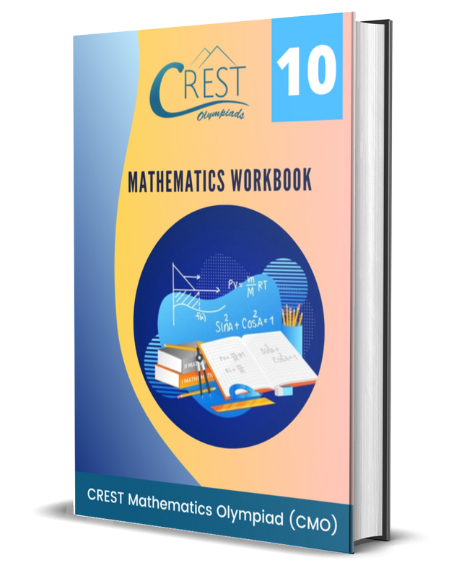
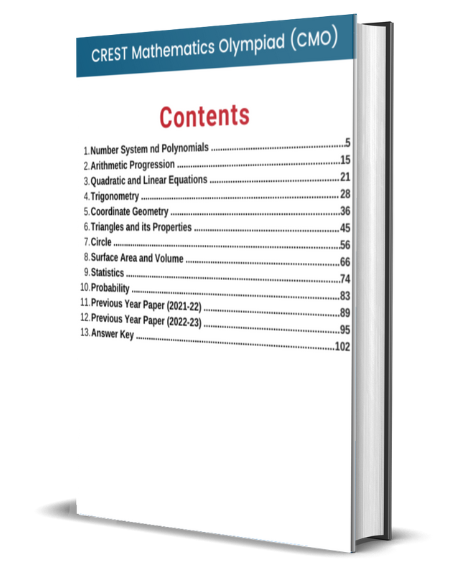
Ten chapters in all: Number System and Polynomials, Arithmetic Progression, Quadratic and Linear Equations, Trigonometry, Coordinate Geometry, Triangles and its Properties, Circle, Surface Area and Volume, Statistics, and Probability. Each has summary notes with the key formulas and then 20 practice questions. A 50-question previous year paper follows, with an answer key that shows the working for most practice questions. It is a printable PDF, downloadable right after payment.
What's inside
- Number System and Polynomials
- Arithmetic Progression
- Quadratic and Linear Equations
- Trigonometry
- Coordinate Geometry
- Triangles and its Properties
- Circle
- Surface Area and Volume
- Statistics
- Probability
Who it's for and how to use it
Class 10 students preparing for the CREST Mathematics Olympiad (CMO) will get the most from it, and it is good practice for SOF IMO and similar olympiads too. Board exams take up much of the year, so plan on two chapters a week through the first term. Then sit the previous year paper in one hour, the time the preface sets, and use the answer key to go through every question you got wrong or guessed.
Sample questions from this workbook
Arithmetic Progression
The third term of an A.P. is 21, and the seventh term is 37; find the sum of 17 terms.
- 918
- 1683
- 1530
- 765
Show answer
Answer: (d) a + 2d = 21 and a + 6d = 37, so a = 13 and d = 4. Sum of 17 terms = 17/2 × (26 + 16 × 4) = 17/2 × 90 = 765.
Surface Area and Volume
In a cylindrical vessel of diameter 12 cm filled up with a sufficient quantity of water, a solid spherical ball of radius 6 cm is completely immersed. What is the increase in height of the water level?
- 12 cm
- 8 cm
- 4 cm
- 2 cm
Show answer
Answer: (b) Volume of water displaced = volume of the sphere. π × 6 × 6 × h = (4/3) × π × 6 × 6 × 6, so h = 8 cm.
Surface Area and Volume
What will be the height of a square pyramid whose base is 18 metres and volume is 2160 cubic metres?
- 12 m
- 44 m
- 40 m
- 20 m
Show answer
Answer: (d) Volume = (1/3) × a² × h. So, h = (3 × 2160) ÷ (18 × 18) = 20 m.