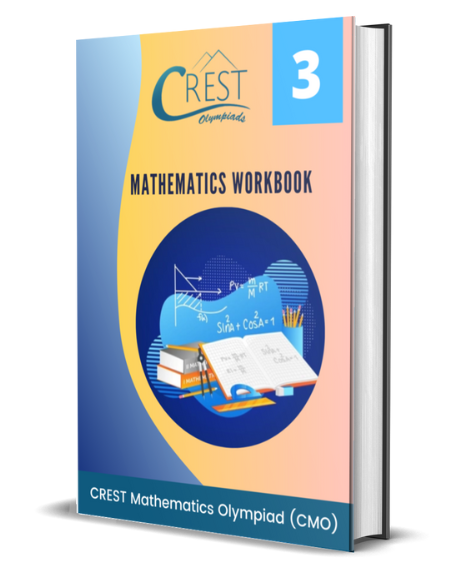
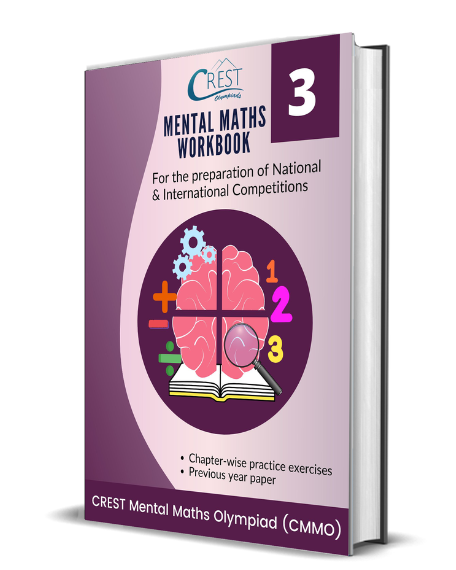
About this workbook
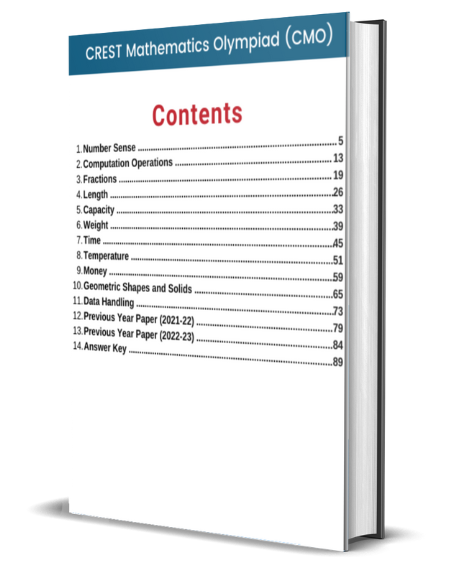
Altogether there are eleven chapters, from Number Sense and Computation Operations through Length, Weight, Time, Temperature and Money to Geometric Shapes and Solids and Data Handling. Each one opens with brief notes, then 20 practice questions. The previous year paper has 35 questions split into Practical Mathematics and an Achiever's Section. In the answer key, most practice questions come with the working shown, so a wrong answer can be traced to the step where it went off. Download the printable PDF straight after payment.
What's inside
- Number Sense
- Computation Operations
- Fractions
- Length
- Capacity
- Weight
- Time
- Temperature
- Money
- Geometric Shapes and Solids
- Data Handling
Who it's for and how to use it
Class 3 children preparing for the CREST Mathematics Olympiad (CMO) are the main readers, though the question style suits SOF IMO and similar school maths olympiads just as well. Two chapters a fortnight is a sensible pace alongside school work. Keep a rough notebook for the multi-step capacity and money sums. Save the previous year paper for last and attempt it in one hour, as the preface recommends, with the answer key closed.
Sample questions from this workbook
Fractions
Convert 15/25 into the lowest form.
- 5/3
- 3/5
- 6/5
- 5/7
Show answer
Answer: (b) 5 is common to 15 and 25. Dividing both by 5 gives the lowest form, 3/5.
Capacity
Sandy conducts an experiment in which he uses 40 mL of water and 56 mL of acid. If the remaining 54 students of the class conduct the same experiment, what amount of acid will be used by all?
- 5280 mL
- 3080 mL
- 2200 mL
- 4850 mL
Show answer
Answer: (b) Sandy and the remaining 54 students make 55 students. Acid used by 55 students = 55 × 56 = 3080 mL.
Capacity
The capacity of container B is 420 mL less than container C and the capacity of container B is twice the capacity of container A. The capacity of container C is 8620 mL. Find the capacity of container A.
- 8200 mL
- 4120 mL
- 4000 mL
- 4100 mL
Show answer
Answer: (d) Container B = 8620 - 420 = 8200 mL. Container B is twice container A, so container A = 8200 ÷ 2 = 4100 mL.