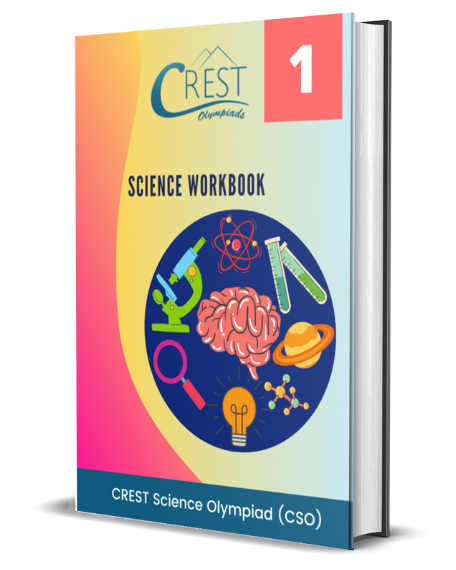
About this workbook
Every chapter begins with short notes, for example the seven features of living things or where different animals live, and then gives 20 questions with four options each. Many use pictures. Others are riddles, jumbled letters to unscramble, or two statements to judge as right or wrong. That is the style olympiad papers use with six-year-olds, so it helps to meet it early.
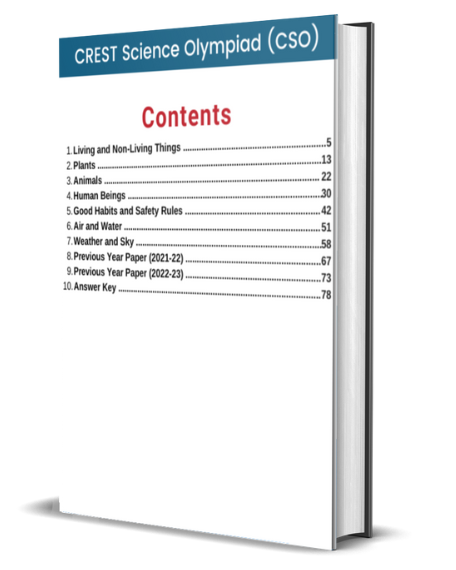
The last section is a 35-question CREST previous year paper, and the answer key lists the correct option for every question in the book. You get it as a printable PDF straight after payment.
What's inside
- Living and Non-living Things
- Plants
- Animals
- Human Beings
- Good Habits and Safety Rules
- Air and Water
- Weather and Sky
Who it's for and how to use it
For Class 1 children preparing for the CREST Science Olympiad (CSO). Because the syllabus overlaps a lot with SOF NSO and other school science olympiads, it works as practice for those too. At this age, sit beside your child, read each question aloud and let them choose. Ten questions in a sitting is plenty. Keep the previous year paper for the end and give it in one go, within the 1 hour the preface allows.
Sample questions from this workbook
Living and Non-living Things
Which of the following is NOT true about living beings?
- Living things do not feel.
- Living things need food.
- Living things grow old and die.
- Living things reproduce.
Show answer
Answer: (a) All living things feel and respond to changes around them, so the statement that they do not feel is the untrue one.
Animals
Which of these are obtained from honeybees?
- Honey and silk
- Honey and leather
- Honey and wax
- Honey and wool
Show answer
Answer: (c) Honeybees make both honey and wax. Silk comes from silkworms, wool from sheep and leather from animal skin.
Human Beings
Identify the room in which family members sit and have their meals:
- Living room
- Bedroom
- Dining room
- Bathroom
Show answer
Answer: (c) The dining room is the room of a house where the family sits together to eat.