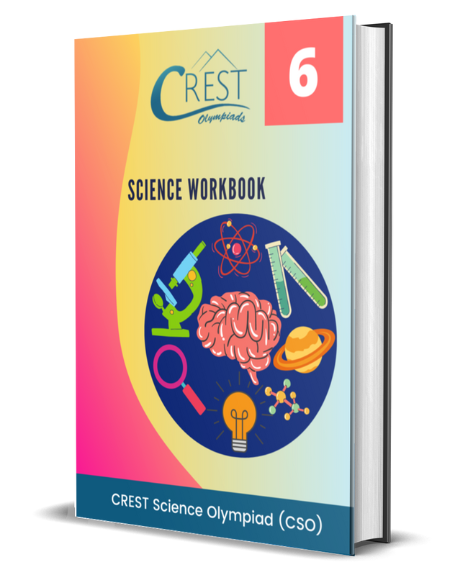
About this workbook
Each chapter gives short notes and then 20 questions. You will find small experiments to predict (what colour appears when Benedict's reagent is added to boiled starch and acid), tables of properties to read, separation methods to choose, and statements about magnets to check.
The answer key gives the correct option throughout, with explanations in chapters such as Food and its Components and Our Environment. A 50-question CREST previous year paper finishes the book. It is a printable PDF, available immediately after payment.
What's inside
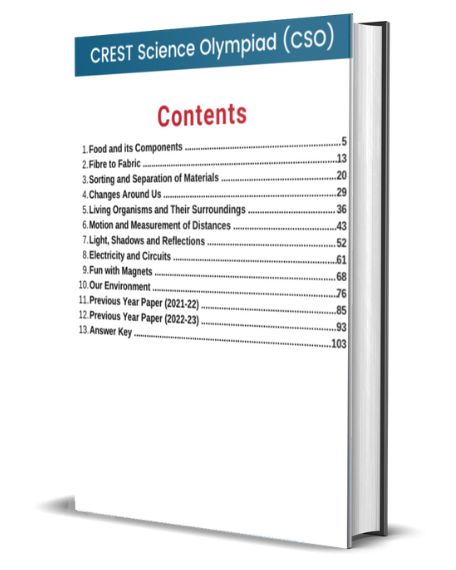
- Food and its Components
- Fibre to Fabric
- Sorting and Separation of Materials
- Changes Around Us
- Living Organisms and Their Surroundings
- Motion and Measurement of Distances
- Light, Shadows and Reflections
- Electricity and Circuits
- Fun with Magnets
- Our Environment
Who it's for and how to use it
For Class 6 students preparing for the CREST Science Olympiad (CSO), and a sensible extra for SOF NSO and other school science olympiads, as the syllabus overlaps a great deal. Doing each chapter alongside the matching chapter in school works well. Once all ten are covered, the previous year paper is the final check: 50 questions in 1 hour, the time set in the preface, with no textbook open.
Sample questions from this workbook
Food and its Components
James performed the following experiment: i. A mixture of starch and acid is allowed to stand for 5 minutes. ii. It is boiled in a bath for 15-20 minutes. iii. Then, 2 drops of Benedict's reagent are added to the test tube. After performing the above steps, what will James observe?
- No colour change is observed
- Orange red colour is observed
- Blue black colour is observed
- Pink colour is observed.
Show answer
Answer: (b) Boiling starch with acid breaks it down into simple sugar. Benedict's reagent then gives an orange red (brick coloured) result, which shows that simple sugar is present.
Sorting and Separation of Materials
What will happen to a hot saturated solution of copper (II) sulphate as the temperature decreases?
- The solvent will evaporate
- Crystals will form
- It will turn colourless
- No change
Show answer
Answer: (b) A cooler solution can hold less dissolved copper sulphate, so the extra salt separates out as crystals.
Fun with Magnets
Which of the following activity will demagnetize the magnet? I. Hammering II. Mixing with sand III. Heating IV. Dropping from a height
- Only I
- Only II
- Only I and III
- I, III and IV
Show answer
Answer: (d) Hammering, heating and dropping a magnet from a height all make it lose its magnetism. Mixing it with sand does not.