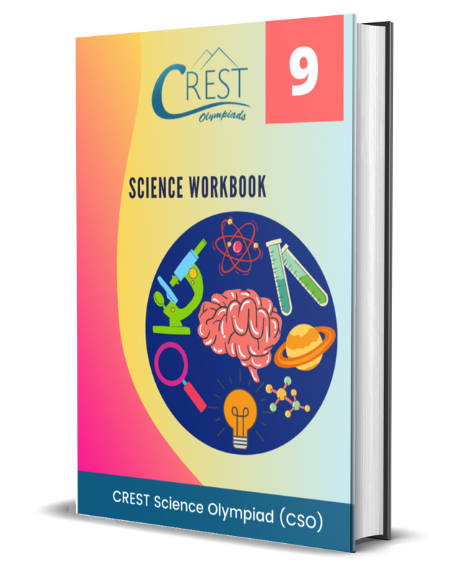
About this workbook
Each chapter has crisp notes with the formulas laid out, then 10 or 20 questions. In Gravitation, for example, students find the weight of an object on a body with three times the Earth's mass and four times its radius, or the height at which an 80 N weight drops to 20 N.
The answer key shows working for several of the numericals and adds short explanations to most biology questions, such as why COVID-19 spreads easily in a crowded bus. A 50-question CREST previous year paper is included. It comes as a printable PDF, available right after payment.
What's inside
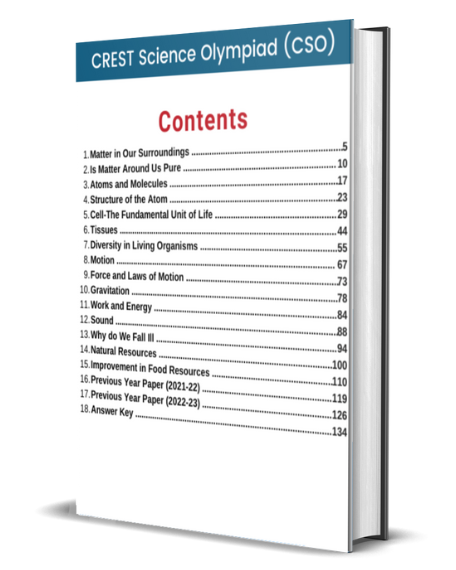
- Matter in Our Surroundings
- Is Matter Around Us Pure
- Atoms and Molecules
- Structure of the Atom
- Cell-The Fundamental Unit of Life
- Tissues
- Diversity in Living Organisms
- Motion
- Force and Laws of Motion
- Gravitation
- Work and Energy
- Sound
- Why do We Fall Ill
- Natural Resources
- Improvement in Food Resources
Who it's for and how to use it
Written for Class 9 students preparing for the CREST Science Olympiad (CSO). It also suits SOF NSO and other school science olympiads, as the syllabus overlaps a great deal. A chapter every week or so works, with extra time on Motion and Gravitation if formulas are a weak spot. Close the book with the previous year paper, timed at 1 hour as the preface recommends, and check it against the key the same day.
Sample questions from this workbook
Gravitation
The gravitational force of attraction between two bodies is 2 N. If the mass of each body and the distance between them are doubled, then calculate the gravitational force between them:
- 2 N
- 4 N
- 8 N
- 1 N
Show answer
Answer: (a) F = GMm/R². Doubling both masses multiplies F by 4, and doubling the distance divides it by 4, so the force stays 2 N.
Gravitation
Consider a heavenly body whose mass is thrice that of the earth and whose radius is four times that of the earth. What will be the weight of the object on this heavenly body, if its weight on the earth is 16 N?
- 16 N
- 9 N
- 3 N
- 4 N
Show answer
Answer: (c) Weight depends on M/R². Here M becomes 3 times and R² becomes 16 times, so the weight is 16 × 3/16 = 3 N.
Why do We Fall Ill
If you are travelling in an overcrowded and poorly ventilated bus, the chances of getting which of the following diseases are high?
- COVID-19
- Polio
- Elephantiasis
- Syphilis
Show answer
Answer: (a) Polio, elephantiasis and syphilis do not spread through aerosols, but COVID-19 does, so a person in a crowded, poorly ventilated bus is exposed to the virus.