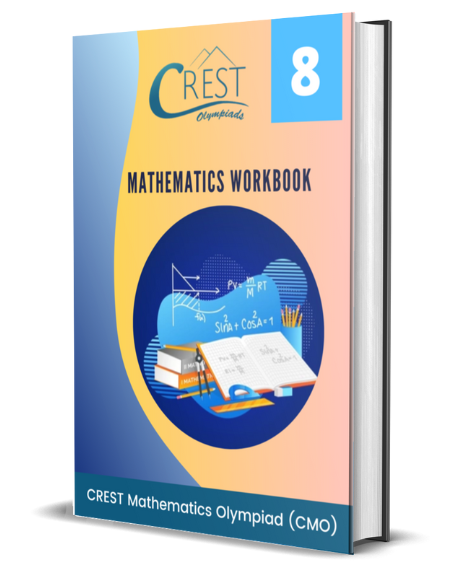
About this workbook
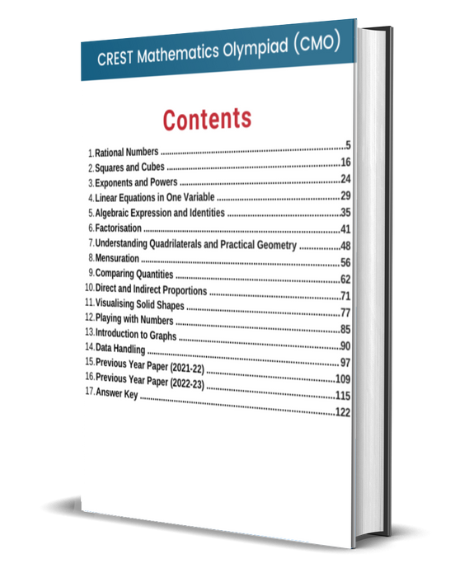
Each chapter has short notes and 20 practice questions, and the book also covers Visualising Solid Shapes and Introduction to Graphs. After the chapters you get a 50-question previous year paper and an answer key with worked solutions for many of the questions. Download the printable PDF right after payment.
What's inside
- Rational Numbers
- Squares and Cubes
- Exponents and Powers
- Linear Equations in One Variable
- Algebraic Expression and Identities
- Factorisation
- Understanding Quadrilaterals and Practical Geometry
- Mensuration
- Comparing Quantities
- Direct and Indirect Proportions
- Visualising Solid Shapes
- Playing with Numbers
- Introduction to Graphs
- Data Handling
Who it's for and how to use it
Built for Class 8 students preparing for the CREST Mathematics Olympiad (CMO), and a good match for SOF IMO and similar olympiads. With fourteen chapters, one a week takes about three and a half months, so start early or move faster through topics your child already knows well from school. Leave the previous year paper until the end and give it one hour, as the preface advises, in one sitting.
Sample questions from this workbook
Direct and Indirect Proportions
If 36 men can do a piece of work in 15 days, then in how many days will 10 men do it?
- 18
- 27
- 42
- 54
Show answer
Answer: (d) Fewer men take more time (inverse proportion). If 10 men take x days, x = (36 × 15) ÷ 10 = 54 days.
Playing with Numbers
Albert subtracted 5 from a number and then divided it by 4. Next, he subtracted 4 from the original number and then divided it by 5. He got the same final answer both times. Find the original number
- 4
- 15
- 9
- 20
Show answer
Answer: (c) If the number is x, then (x - 5)/4 = (x - 4)/5. So, 5x - 25 = 4x - 16, which gives x = 9.
Playing with Numbers
Find the smallest number greater than 600 which is divisible by both 6 and 13.
- 612
- 624
- 648
- 678
Show answer
Answer: (b) LCM of 6 and 13 = 78. The first multiple of 78 greater than 600 is 78 × 8 = 624.