About this workbook
The notes before each set of questions are brief and to the point. The early chapters carry 10 questions each and the physics chapters up to 20, mixing statement checks, labelled diagrams and numericals.
In the answer key, the chemistry and biology chapters come with explanations, while the physics chapters list the correct options. The CREST previous year paper at the end has 50 questions, assertion and reason items among them. It is a printable PDF, yours to download right after payment.
What's inside
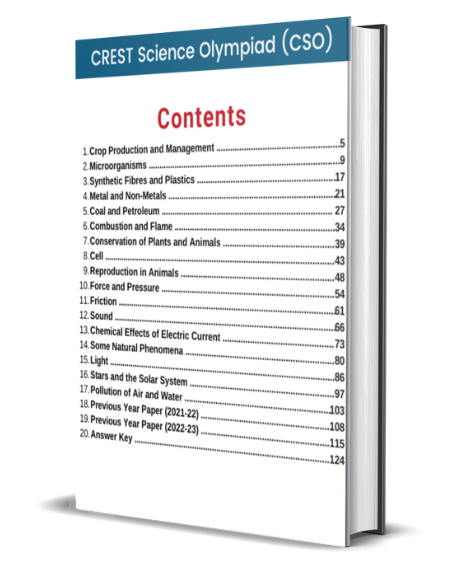
- Crop Production and Management
- Microorganisms
- Synthetic Fibres and Plastics
- Metal and Non-Metals
- Coal and Petroleum
- Combustion and Flame
- Conservation of Plants and Animals
- Cell
- Reproduction in Animals
- Force and Pressure
- Friction
- Sound
- Chemical Effects of Electric Current
- Some Natural Phenomena
- Light
- Stars and the Solar System
- Pollution of Air and Water
Who it's for and how to use it
For Class 8 students preparing for the CREST Science Olympiad (CSO). The overlap with SOF NSO and other school science olympiads is large, so it doubles as practice for them. Pair each chapter with the same one in school, and work the numericals on paper rather than in your head. Leave the previous year paper for the end and give it 1 hour, as the preface sets out, under exam conditions.
Sample questions from this workbook
Coal and Petroleum
Gases condense to liquids on different trays in fractionating column because __________.
- different fractions have different boiling points
- different fractions have different freezing points
- different fractions have same boiling points
- different fractions have different masses
Show answer
Answer: (a) When crude oil is heated, its vapours condense at different heights in the fractionating column because each fraction has a different boiling point. Fractions with lower boiling points rise to the top, while those with higher boiling points condense lower down.
Sound
A person fires a gun in front of a building 146 m away. If the speed of sound is 334 ms⁻¹. Calculate the time after which he hears the echo:
- 1.8 s
- 0.87 s
- 0.98 s
- 1.98 s
Show answer
Answer: (b) The sound goes to the building and back, a distance of 2 × 146 = 292 m. Time = 292 ÷ 334, which is about 0.87 s.
Sound
A tuning fork produces 1075 vibrations in 5 seconds. Find the frequency of tuning fork:
- 210 Hz
- 215 Hz
- 1075 Hz
- 1000 Hz
Show answer
Answer: (b) Frequency is the number of vibrations per second: 1075 ÷ 5 = 215 Hz.